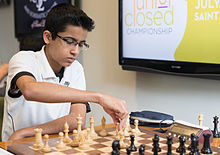
« Daily News editor, Gersh Kuntzman, loses to 16-year-old chess master Akshat Chandra »
« …nothing makes you feel dumber than losing at chess to a 16 year old. I have a good excuse, of course: I’m lousy at chess.
And here’s an even better excuse: I was playing Akshat Chandra, the reigning American junior champ, who is heading this night to St. Louis to compete in the U.S. Championship.
This kid is 90 pounds soaking wet. And he’s a nerdy teenager. And given that there’s no better tabloid trope than the old fat guy competing against the young upstart, I was happy to pretend that I could take him.
But first, I went heavy with Ali-esque intimidation, reading Chandra this poem before we started:
This ain’t no Thrilla in Manila.
It’s more like chess doom in the newsroom
I’m gonna take down Akshat Chandra
Daily News legend Gersh Kuntzman makes a move against U.S. junior chess champion Akshat Chandra in a friendly match at the News’ Lower Manhattan offices. Kuntzman lost the match, but won something greater.
Like disease defeats cell mitochondr’a
He may think he’s a Boris Spassky
But my moves are smoother than French Chablis.
Unlike Muhammad Ali, of course, I float like a butterfly, but sting like a flea.
The match was pretty much done in about six moves, when I made my big mistake — taking his pawn. (Check out the exact moment at about :40 in the video above.) Who knew that taking an opponent’s piece was a bad idea?
“That was when I knew it was over,” Chandra said. “You took the pawn, but in doing so, moved your pawn outside the center. You should have bolstered your strength rather than dilute it.”
What he means is that I shouldn’t have done that.
Chandra did have to think, at least once, during the match.
Another bad move? Anyone who ever read “Bobby Fischer Teaches Chess,” which I read probably 150 times when I was 14, knows you have to castle the king and the rook. But I did it on the wrong side.
“You castled on your queen’s side, which left your position even more unstable and underdeveloped,” Chandra said, using words that mean something different in chess than they do in English. “You should have developed your king’s side.”
He then added, diplomatically, “That was perhaps not the best idea for this situation.”
I lasted roughly two dozen more moves — and even captured both of Chandra’s rooks and bishops — but the kid was toying with me. He check-mated me with little more than a queen and a pawn — which to a chess geek, is the equivalent of being sent to the emergency room after having a pillow fight with Pee Wee Herman.
At least I lasted far longer than the so-called experts thought I would. Before the match, I had called chess writer David Shenk, author of “The Immortal Game,” a seminal history of the sport, for advice. He had none.
Frankly, he predicted I’d only last nine moves.
“There is no way to beat him,” Shenk said. “There is no way to even draw with him. It’s like you’re playing one on one with that guy from the Warriors, what’s his name, Steph Curry.”
Kuntzman graciously accepts defeat.
Shenk’s only advice, “Brush up on your chess for seven years, playing every day against Deep Blue, and then you’ll be in a position to hold off this kid for 11 moves.”
Or I could just be Akshat Chandra.
This kid was your average American boy until he was 9 and his family moved to India, where he couldn’t play the “normal” games he loved: baseball, basketball and football.
So he took up chess — and was so good that he racked up a near-grandmaster rating in just four years. Now he’s in the top 30 players in the entire United States, and has a genuine chance at the nationals that run through April 30.
Ever gracious, he said defeating me was something akin to the best preparation he could possibly have.
“You made me laugh,” he said. “That’s relaxing.”
_________________________
Akshat Chandra (born 1999, Livingston, New Jersey, USA) is an American chess prodigy, who has recorded one of the fastest rises in chess in the world. Akshat’s dramatic rise in chess is unique. He started playing Chess in 2009, when he was about 9 1/2 years of age, during a visit to India. Top players usually start playing chess at the age of 4 to 5 years. Subsequently, when his family relocated to India for a few years Akshat was further drawn into the game. Grandmaster rating level. In May 2015, Akshat crossed the GM rating of 2500 in realtime, reaching the mark in his sixth year after starting Chess.
What makes the achievement even more notable is the fact that the entire rating gain was achieved on the traditional and much lower K-factor coefficient multiple, and not on the new K-factor coefficient multiple introduced by FIDE in July 2014 allowing players to achieve substantially higher point gains for same level of performance as before the change.
In April 2015, at the age of 15, Akshat won the highest Scholastic Chess title in the US – the National K-12 Championship.[ This is the oldest and most prestigious scholastic section championship, not to be confused with the much smaller K-12 grade championship that occurs typically in November/December. In July 2015, Akshat became the US Junior Champion (Closed), which is the top chess title in the US for Junior players under the age of 21 years, and not to be confused with the US Junior (Open) which is a lower-level tournament with the winner securing the right to compete in the Closed championship. This is the first time in US Chess that both the top Scholastic and the Junior titles are held by the same individual in a single year. In April 2013, as a 13-year old, Akshat won the K-9 Super-National championship, which is the top middle-school scholastic championship in the country. All these three championships were won in his first appearance.[2] He did not play the elementary K-5 championship due to his late start in chess.
Akshat has been consistently ranked as the number 1 player in the US in his age category since 2013. He has also been part of the United States Chess Federation (USCF) All America Chess Team for each year, and has qualified to represent the US at the World Youth Championships in all years since 2013. At the age of 14, Akshat won the gold at the North American Youth Championship, U-18 section, in Toronto, Canada.[
Besides success in classical time-control chess, Akshat has also found success in speed chess as well. He is the 2015 National High School Blitz Chess Champion, and is the highest rated Junior Rapid Chess player (U21) in the country.
After learning chess from local part-time coaches, Akshat, at the age of 10, began working with his first professional coach, the Serbian GM Predrag Trajkovic, who worked with him for 4 1/2 years till early 2014. Akshat attributes a lot of his chess knowledge and success to GM Trajkovic’s coaching, which followed the typical Soviet style of chess coaching focused on positional understanding.
Akshat is an avid writer with a worldwide audience as evidenced by comments on his blog and articles in the media. He began writing at a young age, receiving a scholastic award in a national competition. In addition, he took online courses over two years in a creative writing program offered by Johns Hopkins University. Akshat has documented his journey from a beginner to a Grandmaster level on his blog Quest to GM, where more can be learned about him. He is also the youngest regular writer for the most visited chess media website in the world, Chessbase, and also contributes articles to the USCF official website.
Besides growing up in the US, Akshat has also lived in India for a few years, and for a few months in Europe in 2012. As of January 2016, he is a High School Senior.

















 propos d'un jour