An everyday life interiors magazine (issue # 18 winter 2016/2017): « apartamento » of Fernando Arrabal.

« Tower of chess »   and  « Porttrait of Fernando Arrabal » by  Roland Topor

« apartamento »  issue # 18 winter  2016/2017

apartamento magazine (@apartamentomagazine)
https://www.instagram.com/apartamentomagazine/
interview de Fernando Arrabal by Pau Guinart,
Photography by  Josep Fonti

We wait to buzz until 2:21 pm, the exact time we have been appointed. Fernando receives us with his usual double pair of glasses covering his forehead. “Nothing is true or false, it all depends on the color of the lenses you look through” he says. By the front door of his apartment there is a sculpture of a pile of dusty miniature broken cars as an homage to his play Car Cementery. That’s just the prelude of his home-museum. There’s so much art inside that it overflows to the landing.


Arrabal is considered one of the most important playwrights alive in France, but in his home country is still remembered for a TV episode in which he appeared drunk in front of the cameras. He started drinking when he was sixty years old, so he didn’t have a notion of how much alcohol he could handle. After the program he had to be hospitalized, but unfortunately the Spanish audience only remembers those peculiar fifteen minutes of fame. Maybe because of that, he feels very comfortable in his self-chosen exile in Paris.


He was born on August 11 of 1932 in Melilla. He likes to remind people that he comes from Africa. When he was ten years old he won the Spanish national prize for exceptionally gifted children. During the Spanish Civil War his father stayed faithful to the Republic and was condemned to death. His punishment was commuted for life sentence and after going through a few prisons he ended up at the hospital of Burgos. From there he escaped and was never found. Fernando is missing a lung from a tuberculosis operation. He says he actually breathes better like that.

In 1955 he moved to Paris where he met Alejandro Jodorowsky and Roland Topor, with whom he would create the Panico group in 1962. Before that he joined the Surrealist Movement and spent time with Breton, Dalí, Duchamp and Tzara, among others. His apartment is a testimony of such multiplicity of influences. One carpet on the other, like lasagna floor. One painting by the other on the walls: Botero, Topor, etc.

I feel that the stakes are high. Fernando Arrabal is not the easiest person to interview. He talks as Walter Benjamin once prognosticated: with scattered quotes and references. And some gibberish too. At the end they somehow make sense, but always taking into account the limitations of the listener. They say that an interview can only be as good as the interviewer. I think some of the references flew over my head, but I did my best to put them together and make some sense: Controlling the chaos by letting it be. Wasn’t that the premise of the Panico movement?

How did you sleep?

I slept pretty badly actually. And you?

I slept well. May I offer you some wine? Let me open a bottle.

I see you have a very professional set up for visits and interviews here… a few bottles of wine and chocolates.


I really like interviews, they are good for me. I think out loud and audit myself, sometimes even surprise myself. I may in fact hold some sort of interview world-record, because I’ve done a lot.

By the way, you have a pretty nice house. Spacious, high ceilings, maybe a little overwhelmingly decorated though.

Being an artist is, in part, generating spaces of creation. I like to be surrounded by ordered chaos. You know, most artists, especially playwrights lived in deplorable conditions. Breton lived in a janitor room; Beckett in a tiny apartment… the list goes on. I’m extremely lucky with this place; almost no artist has an apartment like this. Milan Kundera lives in a 60 square meters apartment, and so does my friend Michel Houellebecq, although he lives in a top floor of a tower with his wife. He can’t move too much now and needs police protection every time he leaves home. He is pissed. I’m lucky I can walk around freely after some of the things I’ve said.

I see a tower of chessboards there. What do you think about the fact that machines are beating men at chess?

I think it is absolutely normal, we’ve always known that would happen.

How about that garrote vil?

That’s a torture machine. You know that’s how the Spanish condemned to death were executed. Do you want to sit there? Many writers do, some of them have even asked me to kill them with it. Are you ready to die? Do you go to church?

Not really, just the Christmas Eve Mass.

Only once a year? That’s unacceptable. I hope you are at least baptized; otherwise you’ll just hang around in the limbo for eternity. The sacred is essential to understand life. The sacrum bone is the closest to the butthole. Sacred and shit have a lot in common, as Dali insisted.

I see a lot of irreverent sacredness in the artwork that hangs on these walls. Like this Last Supper with Beckett, Borges, Wittgenstein, Kafka… and you as Jesus. I have a question about your presence on so many paintings. Is it sheer narcissism?

You should stop asking the questions you brought, and stop recording this.

Ok (I stop the recorder and put my notes aside)

Your name is Pau right? That’s Paul in Catalan. The apostle Paul was like a secretary, a bureaucrat. Each of the gospels is a version of Jesus, you should do the same with this interview, just write your version of me. The gospel writers didn’t follow Jesus with a recorder, haha… But Pau is a weak name, it sounds like a joke, you should change it.

Oh yea? What do you suggest?

I like Jordi, George in Catalan. I like the connection with the dragon; he is the dragon that kills the dragon. Or just go with your last name: Guinart. It’s powerful. Mr. Guinart. I really like that one. Names are very important. Like Arrabal. Why can’t everybody have a great name like Arrabal?

I guess we would all be the same then. Are you satisfied with the life you had as Arrabal?

Of course I am. How could I not? I had the extraordinary privilege of living. Modernity has endowed me with the responsibility of celebrating figures like Mandelbrot, the great mathematician to whom I recently gave the Prize of Transcendental Satrap. Take into account that when he came up with his theory of fractals, Europe started dividing up. Whereas when the Bourbaki studied the set theory, Europe came together, it was the origin of the unification of Germany, Italy and the Union of Southern Slavs: Yugoslavia. Isn’t that interesting? Geopoliticians have no idea about that, but these theories do have an influence on reality.

You mean that these abstract theories somehow apply to the real world? How about the most important logician since Aristotle: Kurt Gödel?

He is an extraordinary figure. His two incompleteness theorems in many ways represent the state of the spirit of the 20th century. Man unable to understand itself. Did you know he believed in ghosts? Many of the greatest men of science believe in angels, demons and all sorts of unscientific stuff. To me that need for transcendence is utterly fascinating.

Do you think that with Gödel humankind definitively gives up on understanding itself through reason and logic?

I would use a simpler term to explain that: Tohu Bohu. What preceded creation, which in the Bible is understood as the chaos before God gave order to it. It is chaos with the mathematical rigor of confusion.

I’m not sure if I’m following. You mean like a controlled madness?

No, we can’t control anything, we can’t even control ourselves. But at least we have maths to try to understand… However, Thou Bohu is always beyond. Thou is an inhabitable desert, commotion and agitation before God’s intervention, and Bohu is the confusion of the moment of creation. Where there’s no confusion, there’s nothing. There’s no point on trying to understand everything.

That all sounds very confusing. Is it because you like spreading chaos? Excuse me if I offend you, but I can’t help but seeing a deliberate Dionysian enactment in your performance.

Not so much Dionysus, but Pan. He makes you laugh, but when you turn around he is totally unpredictable. That’s why he creates panic and madness. Dionysus is too round, cyclical, circular, like the seasons. Pan is more confusing, and therefore more interesting. He reconciles contraries with the mathematical rigor of confusion. With the Panico movement there is something like a rationalized frenzy, controlled by mathematics and logic. Thou Bohu.

What is pataphysics?

It is what is beyond metaphysics, a science of imaginary solutions. A branch of a branch of fantastic literature. According to its founder Alfred Jarry, the world is an exception to the exception, that is why there can be regularity. Underneath reality there is only chaos. That has to do with Wittgenstein threatening Popper with a poker in Cambridge… We basically try to make sense of chaos.

You always refer to Cervantes as your inspiration. Who else has inspired you? Dali, Valle-Inclan, Unamuno…

If you undust any part of Dalí, it is huge. What he says in 1937, 38, 39… it’s huge! His relationship to sex for example… People like Unamuno or Valle-Inclan are tiny figures compared to Dalí.

How about Calderon or Lorca?

About Lorca, Dalí said the exact precise thing. When Lorca, who was in love with Dalí, read out loud his Romancero Gitano to Buñuel and him, Buñuel, who always told the truth, said that the book was horrible. Lorca turned to Dalí with despair, asking him how could Buñuel not like that book when it had been so successful all over Spain. Then Dali responded the essential, as usual: this book is not bad, but it lacks trains. It’s like writing a book today without Internet. He was always so precise! It lacks trains…

I see you are very connected with the present, is that an Iphone 6?

Yes. I’m 83 and I try to keep up with the times. I also hand write notes on the case though. I use both analogic and digital.

How about the rest of the European tradition? What inspires you?


Our civilization, which is extraordinary, has only created two myths: Faust and Don Juan. The monk Tirso de Molina did a great job with that. The world of seduction… Dali actually wanted me to seduce Gala. He wasn’t really interested in sex, but in my presence he did very sexual things.

Like what?

He liked to be surrounded by weird people: mentally, sexually… like Amanda Lear, to whom he paid a trip to Casablanca as a man and came back as a woman. But he wanted me to seduce Gala, and I still don’t understand why, because seduction doesn’t really exist.

What do you mean? I see it everywhere, especially in literature.

Seduction is a lie. The monk Tirso de Molina tells the truth: Don Juan wants to fuck four girls, and in order to do that, he lies to them, but none of them falls in love with him. When other European authors understand that, they copy it and make it better: one of them is Molière, and the other is Mozart with his opera Don Giovanni. But seduction is still a lie, and thus it is never real, it is a contradiction in itself.

How does seduction work in Dalí, if there is anything like that.

Dalí was interested in the possibility of an explosion. This is a long story, but worth telling: Gala and Paul Éluard live with Max Ernst and have a love triangle. Éluard sends a letter to Ernst saying that he loves Gala because she is a formidable woman and she incarnates all the Russian spirit, but that he loves him even more. The surrealists, with Breton leading the group, couldn’t stand that. Until the last moment Gala keeps writing letters to Éluard, who has other women… but when he writes back to Gala he ends his letters with things like: “I make love to you” or “I penetrate you”. And Dali doesn’t give a damn about all that, because he is not attracted to Gala per se, but to the bizarre situation that the whole thing generates. He likes the fact that something strange is created, something that can unleash a hurricane at any point, but doesn’t. What he likes is masturbating, and that’s what he talks about in his real biography: the one he wrote when he was 17.

Tell me about one of your anecdotes with Dalí.

Once I visited him with five chained women… They were lesbian Maoist revolutionaries and came from Lyon to interpret my play Fando and Lis. I received a call from Dalí saying he wanted to perform a cybernetic work at midnight. When the five women heard it they went wild, they really wanted to come with me. I said “fine, but we can’t just show up there. It has to be somewhat special… you have to come chained. I’m going to chain you!” But chaining someone is not as easy as it seems. We had to go to the Bazar of the Hotel de Ville, where we bought five meters of chains and the concierge lent us a few locks.

I can imagine Dalí really liking your idea…


Of course! He absolutely loved it. He was at the luxurious hotel Le Meurice, where the Nazis had their Kommandatur when they occupied Paris. When we got there, before I even asked, the doorman said: “Suite 103”. We went up the room and Dali was ecstatic: “They are my five slaves!” he shouted. But I wasn’t that sure, so I told him that none of them were at his service, and that they wouldn’t do anything against their will. But then one of them took her panties off and said “I want you to slap my butt!” I was surprised, but decided to just enjoy the spectacle of Dalí hitting her with a nard. As hard as it is to find a nard in Paris…

And what happened next?

He said that the “salve” and I should go to an orgy with him that night. I then said that I was a chaste man and that I wouldn’t get involved. He got even more enthusiastic and assigned me the role of “chaste voyeur”.

Do you identify with that role? I see you are very interested in sex… How about that painting with a naked man embracing a huge penis?

It is very simple: men have a small penis and they wish they had one as big as that. We all wish we were bigger, in every sense…

What do you think about life?

I am extremely lucky for not having to fight for anything except for dreaming.

The time is up. I tell him that I will have to do a lot of hermeneutics in order to write something worth reading. I quote Dalí “Let them talk about me, even if what they say is good” expecting his complicity. He gives me a dirty look, which I interpret as “Don’t you dare write nonsense for my interview”. I tell him I’ll send him a draft before publishing it… but I won’t, it would be too risky.

Ok, thank you very much for your time. It’s been a pleasure

Thank you, it’s been my pleasure.

I hope I can compose something interesting out of this chaos…

You’d better; otherwise I’ll whip your ass.

The interview ends at 3:37 pm. The artistic director of an opera and his assistants enter the apartment punctually. They want to propose him to adapt Fando and Lis. He stares at me with condescendence as I leave the place. Then he stands up, walks across the whole room and hugs me warmly. He looks up. I see a little child in his playroom: Arrabal as a self-made child.

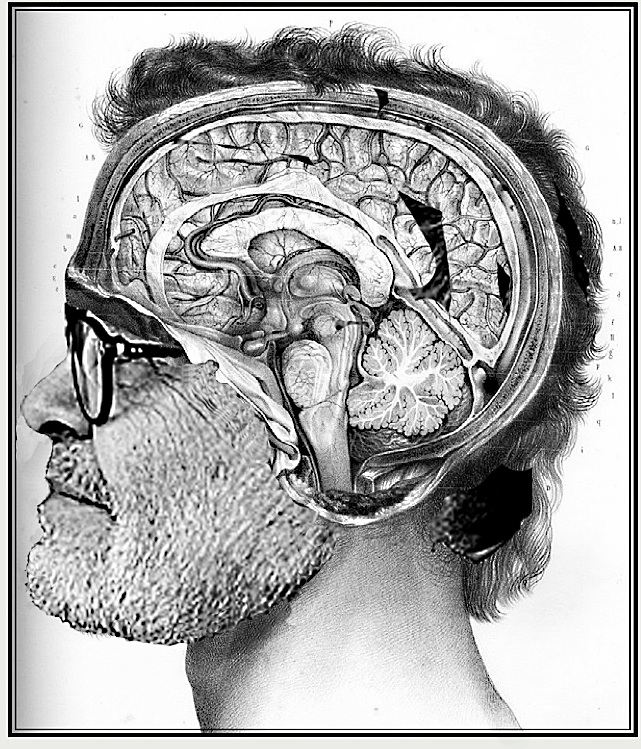


Les vagues unies de la terre ferme pataphysicienne: AUJOURD’HUI (hoy).

collage-jsoler-28-xii-16

Collage de Jordi Soler

Aujourd’hui (hoy): 1er decervelage 144 (vulg. jeudi 29 décembre 2016) pataphysicien.

…du RHSM Thieri Foulc :

Collège de ’Pataphysique
Les pataphysiciens encourageront les exercices décervelants et seront prêts à s’aventurer sur les vagues unies de la terre ferme
ce 1er décervelage  144

(vulg. jeudi 29 décembre 2016)
de 18 heures à 20 heures
au 51A rue du Volga, Paris 20e
(métro : Maraîchers).

***

Jean-Baptiste Marc Bourgery (May 19, 1797 – June 1849) was a French physician and anatomist who was a native of Orléans.  In 1830 he began work on « Traité complet de l’anatomie humaine comprennant la médicine operatoire » (1832-1851), a masterpiece on human anatomy  that was published in eight volumes.  The illustrative work was performed by Nicolas-Henri Jacob (1782–1871).

Frontispice of « Traité… ».

Uma obra de Fernando Arrabal Direçao Luiz Campos. Cia. Los Puercos « A Oraçâo ».

Cia.  Los Puercos « A Oraçâo »  Uma obra de  Fernando Arrabal   Direçao Luiz Campos.

« A Oraçâo »

Uma obra de  Fernando Arrabal

Direçao Luiz Campos

com Giovanna Marcomini

Nathalia Nigro

Na Oficina Cultural Oswald de Andrade

Rua Três Rios, 363

Bom Retiro

Sâo Paulo/SP

Sao Paolo

« …hecho con una gran cantidad de sudor, sangre, lágrimas y esperma »: Los Puercos

___

ANTONY HOPKINS, LAURENCE OLIVIER and ARRABAL: « The best thing he has done in years ».

« The best thing he has done in years »: ANTONY HOPKINS, LAURENCE OLIVIER  and   ARRABAL.
Stage Managing CHAOS (2016/17) : A Diary of the Old Vic Production of Fernando Arrabal’s the Architect and the Emperor of Assyria
ANTONY HOPKINS , SIR LAURENCE OLIVIER , VICTOR GARCIA and  FERNANDO ARRABAL

In the early 1970s London’s National Theatre, led by Sir Laurence Olivier, launched an infamous avant garde production of The Architect and the Emperor of Assyria. Concerned that his classical approach would clash with the enfant terrible director, Victor Garcia, Olivier enlisted stage manager Jackie Harvey to keep a diary of the often ludicrous, occasionally creative, always challenging rehearsals. Anthony Hopkins and Jim Dale costarred in the surreal two-man piece. Led by the eccentric Garcia, the play quickly descended into a chaotic and « xenius » theatre. Missed deadlines, technical hitches, unauthorized…

___________________________________________________________

THE ARCHITECT AND THE   EMPEROR  OF ASSYRIA by Fernando Arrabal.

By CLIVE BARNES (The New York Times)

« The best thing he has done in years »


Presumably, even critics develop. When I first saw Fernando Arrabal’s play “The Architect and the Emperor of Assyria” at Britain: National Theater. I was modesty somewhat unimpressed.

I did not really understand it -perhaps simply because all critics are slightly behind their times. It is not so much an occupational hazard as an occupational disease, and should be recognized as such and treated kindly. We do our best. On Friday night at the La  Mama Annex on East Fourth Street, the Nelly Vivas Company gave the Arrabal play its New York premiere, and

I was overwhelmed. It was a great theatrical experience.

A play about relationships that genuinely related. Now the simple explanation in such circumstances is to say that the second staging was so much better. But I suspect it wasn’t. The National Theater production was staged by the brilliant South American director Victor García and it starred Jim Dale and Anthony Hopkins.

No care had been spared.

But for me it didn’t really work  -I was interested but totally puzzled. Now at La MamaTom O ‘Horgan has staged it -it is the

best thing he has done in years -in a very different fashion, and I found it most beautiful and interesting.

The play is concerned with two people living together, and the games they play, the roles they assume the gestures they make. It has the fantasy of the poetically sane.

There are two people: One is the Architect and the other is the Emperor -it might be thought that they symbolize special aspects of life.  But that would not be quite true. Mr. Arrabal is more subtle than that. Indeed, just as all dreams and all fantasies that  one has emerge from the single psyche, so indeed both of these men, arguing, accusing,condemning, fighting, lovingand losing, could indeed be a representation of one person.

On one all too human soul in conflict. But probably not. There does seem to be an dialogue here, and a dialogue not between the contradictory forces of human nature, but a dialogue between two people missing out in love.

They embrace, they devour, they die It is the texture of the play that is so fascinating and important. It has layers to it. At one time you think you are seeing this, at another time you are confident you are seeing that. If the art of poetry is ambiguity raised to level of either dreams or nightmares -and. by the way,it is- then this play is almost impossibly poetic.

The language floats, jumps and sparkles. It has been translated by Everard d’Harnoncourt and Adele Shank.and quite obviously they havedone a fine job. There is adazzling madness of wordsscattered across the airy

like diamante stars.

The play is a confrontation.It takes place on an island. Two people confined and in conflict and in love. The Architect and the Emperor -the two symbols, perhaps, of the human conditionon its creative level. Or, perhaps, the way we all, all of us, are -the titles themselves carry their own message. But interestingly Mr. Arrabal permits the two of them -these two aspects of personality- continually to switch roles.He is saying that in all of us there: is an Architect someone who needs to build and control, and an Emperor who needs to reign.

The concept is interesting, of course,but what makes it compelling is Mr. Arrabal’s brilliant use of it. The man dreams in the images of reality. He reminds me of another Spanish artist. Goya-and the Caprichos sketches- the « dream, » as Goya put it, “of reason produces monsters. »

Mr. Arrabal is severely anticlerical -his attacks on the church are bloody and unbound -but he may even be severely antihuman. One has a sense -a feel you have for another satirist such as Jonathan Swift- that he has looked at us carefully , perhaps, at least hopefully, but too carefully, and found us disappointing.

The play does play God but it plays it very convincingly.

One reason of course is Mr. O‘Horgan’s elegantly inventive production, which stages the play with precisely the explosive exposition that its statement demands, and also the acting. There are two alternative casts. On the night the roles were taken with love and care by Lazaro Pérez as the Archi- tact and Ronald Perlman as the Emperor. They were brilliant in evening of dizzy revelation.

Mr. Arrabal with his perceptions, absurdities, and understanding is

a playwright to be honored, treasured

and understood. In this play he is saying something about the isolation, the solitariness and the need of man that, so far, as I can, see, no other playwright has quite gotten on stage before. A playwright reveals, himself when in the electric instant of the moment he tells us the story of our lives.

Mr. Arrabal does that with the grace of the fantastic and the gaucheness of the real.


 The New York Times.   

Drama: los Hombres de Arrabal.

« The Architect and de Emperor » centelleantes.

Por CLIVE BARNES (traducción de Lelia Fischer)

« …ningún otro dramaturgo ha logrado antes  presentar  en  las tablas… »

Probablemente incluso la critica  hace progresos. Cuando vi por primera vez la pieza de Arrabal en el Britain National Theater quedé moderadamente impresionado. No la comprendí realmente- quizá tan solo porque todos los críticos  suelen tener  un leve  retraso con relación a su época. No se trata  tanto de un riesgo profesional como de una enfermedad profesional que tendría que ser identificada como tal  y,  por eso,  debería ser considerada con indulgencia. Actuamos lo mejor que podemos .

La noche del viernes  en La Mama Annex en la  East Four Street (en la calle cuatro) la compañía de Nelly Vivas presentó el estreno de la obra de Arrabal y  quedé sumergido. Fue una gran experiencia teatral. Una obra que trata de las relaciones familiares  que realmente relacionaba.

Ahora bien la explicación sencilla en tales circunstancias consiste en decir que la segunda dirección era mucho mejor. Pero sospecho que no era tal. El montaje en el National Theater fue dirigido por el brillante director sudamericano Víctor García y  los protagonistas fueron Jim Dale y Anthony Hopkins. Literalmente : pusieron toda la carne en el asador. Pero para mi algo realmente no funcionó.-me interesaban pero estaba  totalmente desconcertado

Ahora  bien  en la Mama es Tom O’Horgan  quien la ha dirigido -y es lo mejor que ha hecho desde hace años -de una manera muy distinta y me pareció más hermoso e interesante.

La obra trata de dos personas que viven juntas y de  los juegos con que se divierten,  los papeles que desempeñan , de su modo de actuar. Era la fantasía  de lo poéticamente fenomenal

Hay dos personas: Una es el Arquitecto y la otra el Emperador – podríamos imaginar que simbolizan particulares aspectos de la realidad. Pero no sería  del todo  cierto. El Señor Arrabal es mucho mas sutil que eso. En realidad, exactamente como  todos los sueños y fantasías que tenemos surgen de una única psique, igualmente estos dos hombres que discuten, acusan, condenan , combaten, aman y pierden podrían realmente representar (a) una única persona. En una toda el alma y sus conflictos. Pero probablemente no. Aquí parece que se trate de un dialogo, y un dialogo no entre las fuerzas contradictorias  de la naturaleza humana, sino un dialogo entre dos personas carentes de amor.  Se abrazan, se devoran, y mueren.

Es la trama (textura) de la obra la que es tan hechizadora e importante. Hay diferentes grados en ella. A veces crees que estas viendo tal cosa, en otro momento estas seguro de que estas viendo otra. Si el arte de la poesía es la ambigüedad elevada al nivel de sueños o pesadillas – y, dicho sea de paso, este es el caso- entonces esta obra es casi imposiblemente poética.

El lenguaje flota, salta y centellea. Ha sido traducido por Everard d’Harnoncourt y Adèle Shanks y con toda evidencia han hecho un excelente trabajo. Hay una  deslumbrante locura de palabras cruzando lo etéreo :  como estrellas de diamantes.

La pieza es una confrontación. Se desarrolla en una isla. Dos personas confinadas y con conflictos y amor. El Arquitecto y el Emperador -quizá los dos símbolos de la condición humana  a su nivel creador. O, quizá el modo en que todos, todos   nosotros somos -los títulos, en sí mismos  llevan su propio mensaje. Pero de un modo interesante el Señor Arrabal permite a los dos -estos dos aspectos de la realidad-   constantemente intercambiando sus papeles. Está diciéndonos que en todos nosotros hay una arquitecto, alguien que necesita construir y controlar, y un emperador que necesita reinar. La idea es  interesante, naturalmente, pero lo que la hace irresistible es la brillante manera con que  la emplea   el Señor  Arrabal . El hombre sueña con las imágenes de la realidad. Me recuerda a otro artista español: Goya y sus estampas, sus  Caprichos-  el « sueño » según Goya « de la razón engendra monstruos ».

El Señor Arrabal es tremendamente  anticlerical -sus ataques a la Iglesia son sangrientas y desencadenadas -pero pueden ser incluso tremendamente antihumanas . Uno tiene la misma sensación – que se tienes con  otro « autor satírico » como  Jonathan Swift- que  nos ha mirado cuidadosamente, quizá, al fin y al cabo con esperanza, pero con excesivo cuidado, cuando le decepcionamos.

La obra juega verdaderamente a ser Dios pero juega de una forma convincente. naturalmente uno de los motivos es el montaje elegantemente inventivo del sr O’Horgan que dirige la obra  con precisamente la explosiva exposición que requiere su plasmación, y también el trabajo de los actores. Hay dos elencos alternativos . Esa noche los papeles los desempeñaban con amor y cuidado Lázaro Pérez: el Arquitecto y Ronald Perelman el Emperador. Fueron  se lucieron en una noche  de vertiginosa revelación.

El Señor Arrabal con sus percepciones, absurdos y comprensión es  un dramaturgo   que debe ser honrado,  y atesorado, y entendido. En esta obra esta diciendo algo sobre  el aislamiento, la soledad y lo que necesita el hombre que, tan lejos como puedo distinguir, ningún otro dramaturgo ha logrado antes  presentar  en  las tablas. Un dramaturgo se revela cuando en  el eléctrico instante del momento nos cuenta la historia de nuestras vidas . Esto hace el Sr Arrabal con la gracia de lo fantástico y la torpeza de lo real.

The Cast

THE ARCHITECT AND THE   EMPEROR

OF ASSYRIA by Fernando Arrabal.

Directed by Tom O Horgan;

settings by Bill Stablie;

lighting by Cheryl Thacker;

costumes by Joseph Aulisi.

Written in l965 translated

by Everard d’Harmoncourt and Adele Shank.

Production coordinator, Nelly Vivas.

Production Stage managers, Marc Cohen.

Galan Mc Kinley.

La Mama Annex presents Nelly Vivas Company.

At La Mama Annex, 66 East Fourth  Street .

The Architect……..………………..Lazaro Perez

The Emperor.………………….Ronald Perlman

___________________________________

« Compagnie de 3 comédiens 3″: »FANDO et LIS » d’Arrabal.

« FANDO  et  LIS »  (1958)

de Fernando Arrabal

« Compagnie de 3 comédiens 3  Nicolas, Najda et Mehdi »

France et  l’étranger (Mexique)

Écrit en 1958 – français

Fando et Lis, deux adolescents presque adultes, font route vers Tar, une ville extraordinaire, mythique. Personne n’y est jamais arrivé paraît-il, ou en tout cas, personne n’en est jamais revenu. En chemin, ils rencontreront trois hommes un peu étranges, Namur, Mitaro et Toso, en route pour la même quête.Fando est un personnage qui, à l’image d’un enfant (de l’enfant que chaque adulte enfouit au plus profond de lui), est naïf et tyrannique. Il exerce sur Lis, sa jeune compagne handicapée, une domination affranchie des tabous de la morale.
Méchant et repentant, tout en lui est dualité.
Et cette dualité se concrétise avec l’apparition plutôt fantomatique des trois personnages-marionnettes, issus de l’imaginaire de Fando. En perpétuel conflit, leur apparence tordue et rigide contraste avec l’agilité physique de leur créateur. L’infirmité de Fando n’est pas corporelle, elle se situe au niveau psychique et émotionnel. Elle s’oppose à celle de Lis, le personnage qui, par ailleurs, incarne la sagesse, une sagesse opprimée, dont le pouvoir est entravé.

Nombre de personnages
  • 4 homme(s)
  • 1 femme(s)

C I R C E (Alemania): Fernando Arrabal « Fando y Lis » Rodolfo Tenorio.

Fernando Arrabal  « Fando y Lis »  C I R C E (Alemania) Rodolfo Tenorio.

La obra de Fernando Arrabal 

« Fando y Lis »  

Rodolofo Tenorio: director de teatro,

…au tic-tac  de la pendule Pan épingle la foudre
… al tic tac del reloj Pan prende  truenos.

Centro de Investigación irracional Corporal y Escénico (C.I.R.C.E.)  combina distintas técnicas teatrales para obtener montajes escénicos y llevarlos en los lugares donde la oferta cultural es muy baja o nula para que todos puedan gozar del teatro.  En Alemania.
Yo me encargé de traducirla al alemán ( a pesar de que existen varias )
Producción independiente .

http://circefortune.wixsite.com/teatroirracional

Prix Nobel et Bob Dylan: Fernando Arrabal.

images

How many roads must a poet walk down
Fernando Arrabal

[laregledujeu.org,  Le Monde, ABC de Madrid 10-XII-16]

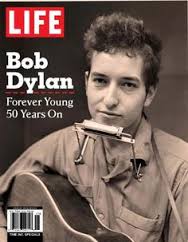
Bob Dylan, avec ses ‘illuminations’, a reçu le  Nobel de littérature.  « Pourquoi essayer de me changer maintenant?  » . Je suis ravi que l’on ait attribué un prix  prestigieux  à l’une des formes artistiques les plus poétiques des XXè et XXIè siècles. À mon modeste avis le rock, et particulièrement Bob Dylan, le méritent. Fini le rap, maintenant Mr. Man  joue du « tambourin ». How many roads must a poet walk down.

Comment dire sans paraître flagorneur que ce  prix littéraire est évidemment prestigieux? Et même comme la plupart des trophées décernés ici ou là. Quand le clone de la Cheeta de Tarzan se change en nain de Blanche-Neige. Les jurys de toutes les distinctions se montrent généralement équitables. En cette époque de raz-de-marée même un rat des champs découvre le feu. On rappelle avec aigreur les cas de Joyce, Kafka, Borges et autres oubliés. Il est logique qu’un juré dépourvu du don d’infaillibilité ne  vise pas toujours juste. Mais, parfois, il y parvient. Comme dans le cas de Beckett. Pour le Collège de ’Pataphysique  le prix Nobel n’est pas « un  lourd handicap ». De fait, par deux fois, Nobel a choisi deux de ses quarante-neuf « transcendants»  pataphysiciens. La terre est ronde mais certains la préfèrent plate. Le monde et ses big prizes devraient vraiment beaucoup changer pour imaginer que   la grenouille puisse être un jour aussi grosse que le bœuf. How many roads must a poet walk down.

En général ces prix ne font que changer la vie domestique de la plupart des heureux élus. Suzanne Beckett (et son mari) cessèrent de vivre dans douze mètres carrés. Elle acquit ce qu’elle pouvait trouver de mieux avec le million. Un petit appartement à Paris, six fois plus grand. Par inadvertance, donnant sur la cour de la Santé. Comme réveille-matin elle dut acheter un serpent à sonnettes. How many roads must a poet walk down.

Jean-Paul Sartre refusa le prix et son million. A la hussarde ! Mais au dernier moment, alors qu’il n’avait même pas de quoi se payer « un paire de chaussettes », il récupéra le chèque. Certains deviennent clochards à cause de leur chimères. Le Castor (Simone de Beauvoir) raconte que  peu avant son occultation il lui avait demandé : « comment ferons-nous pour faire face aux frais d’enterrement? » Les académiciens suédois lui rendirent ce qui lui revenait. En oubliant qu’il avait expectoré sur eux. Et dans leur soupe. Cette académie, grâce à ses skis d’avant-garde, est en avance sur son temps. How many roads must a writer  walk down.

Parmi les écrivains  non récipiendaires des lauriers personne n’a pour habitude de se plaindre. Au contraire !  Alfred Jarry avant de mourir de faim aurait pu recevoir sept prix Nobel. Jusqu’à son dernier soupir il agit comme si dans tout avenir il n’y avait aucun futur. À 34 ans lui, sa soeur et complice Charlotte, burent 1100 litres de vin en six mois. Rien qu’à eux deux: 183 par mois, c’est-à-dire trois litres par jour et par personne. Pour plus de précision : on possède les factures de leurs créanciers jusqu’à leur occultation. Il y avait longtemps que les Jarry ne vivaient plus en temps réel. How many roads must a poet walk down.

Sans mérite de ma part j’ai reçu des prix comme le “Ludwig Wittgenstein” de philosophie, le “Pier Paolo Pasolini” de cinéma, le “Antonin Artaud” de Théâtre, le “Vladimir Nabokov” de roman, le “Mariano de Cavia” de journalisme, ou le  “Alessandro Manzoni” de poésie. Le Collège de ‘Pataphysique m’a nommé (comme remplaçant de Boris Vian et Eugène Ionesco) « promoteur » de ses « ordres ». C’est une fonction idéale. Sans voix ni  vote. Mais qu’attendent les poissons volants? Chaque fois que par mégarde je propose un nom au Collège, on me répond régulièrement avec courtoisie :
-Vous avez raison, l’oeuvre musicale (ou mathématique, ou échiquéenne) de NN est admirable mais, malheureusement, elle n’est pas pataphysique. La « nuit des étoiles » serait plus belle à midi. How many roads must a poet walk down.

Fernando Arrabal

_______________________________________________________

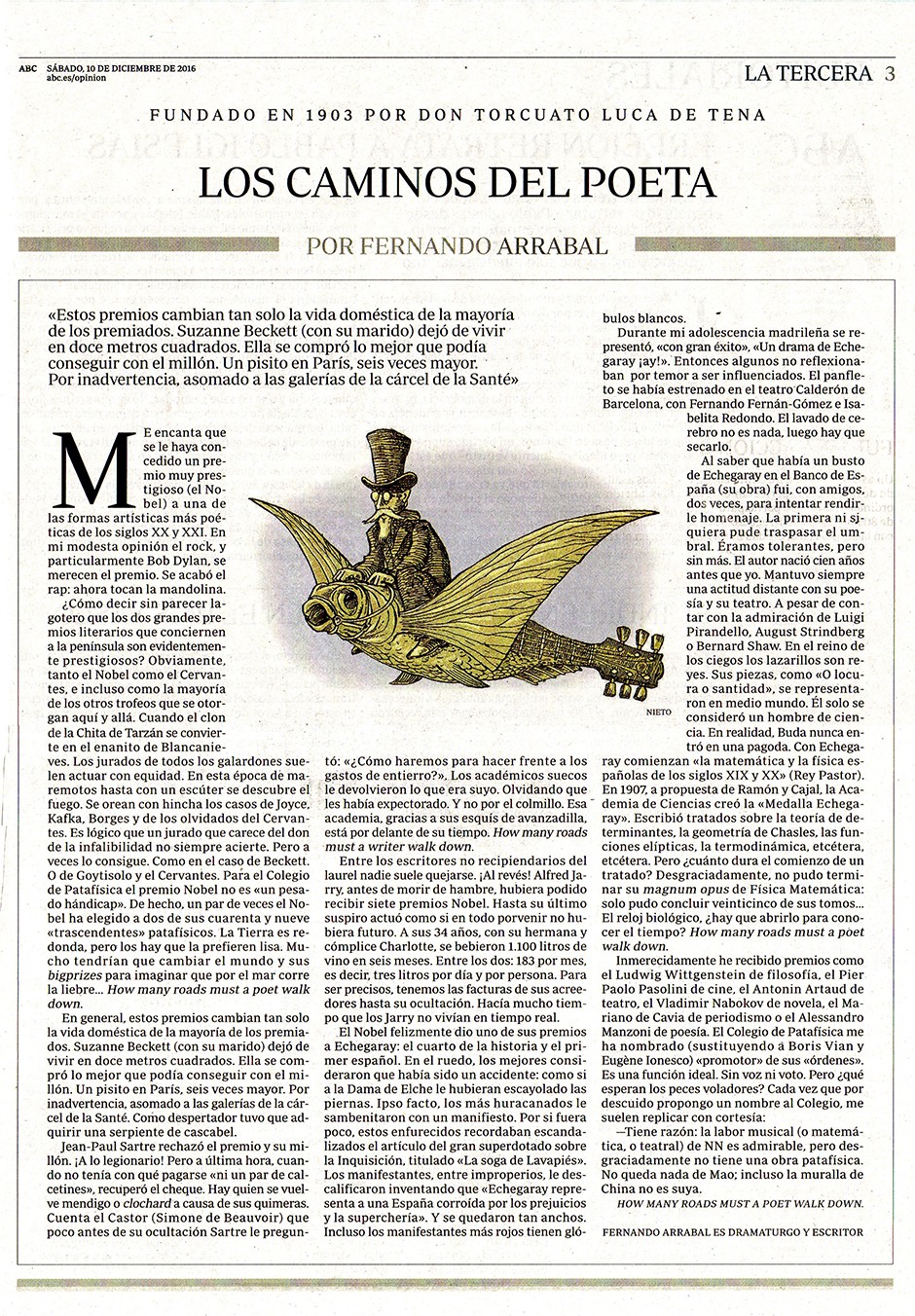
How many roads must a poet walk down
Fernando Arrabal
[Tercera de ABC, la regledujeu.org, le Monde, 10-XII-16]

Bob Dylan, con sus iluminaciones,  ha  recibido el Nobel de literatura.  « ¿Por qué intentar cambiarme ahora? ».  Me encanta que se  se le haya concedido un premio prestigioso  a una de las formas artísticas más poéticas de los siglos XX y XXI. En mi modesta opinión el rock, y particularmente Bob Dylan, se  merecen el premio. Se acabó el rap: ahora Mr Man toca et tamborín. How many roads must a poet walk down.

¿Cómo decir sin parecer lagotero, que los dos grandes premios literarios que conciernen a la península son evidentemente prestigiosos? Obviamente tanto el Nobel como el Cervantes. E incluso como la mayoría de los otros trofeos que se otorgan aquí y allá. Cuando el clon de la Chita de Tarzán se convierte en el enanito de Blancanieves. Los jurados de todos los galardones suelen actuar con  equidad. En esta época de maremotos hasta con un escúter  se descubre el fuego. Se orean  con hincha los casos de Joyce, Kafka, Borges y de los olvidados del Cervantes.  Es lógico que un jurado que carece del don de infalibilidad no siempre acierte. Pero a veces lo consigue. Como en el caso de Beckett. O de Goytisolo y el Cervantes. Para el Colegio de Patafîsica el premio Nobel no es “un  pesado hándicap”. De hecho un par de veces Nobel ha elegido a dos de sus cuarenta y nueve “trascendentes” patafísicos. La tierra es redonda pero los hay que la prefieren lisa. Mucho tendría que cambiar el mundo y sus “big prizes” para imaginar que por el mar corre la liebre… How many roads must a poet walk down.

En general estos premios cambian tan  solo la vida doméstica de la mayoría de los premiados. Suzanne Beckett (con su marido) dejaron de vivir en 12 metros cuadrados. Ella se compró lo mejor que podía conseguir con  el millón. Un  pisito en París, seis veces mayor. Por inadvertencia asomado a las galerías de la cárcel de la Santé. Como despertador tuvo que adquirir una serpiente de cascabel.

Jean-Paul Sartre rechazó el premio y su millón. ¡A lo legionario! Pero a última hora, cuando no tenía con qué pagarse “ni un par de calcetines”,  recuperó el cheque. Hay quien se vuelve mendigo o “clochard” a causa de sus quimeras. Cuenta el Castor (Simone de Beauvoir) que poco antes de su ocultación Sartre le preguntó:  “¿Cómo haremos para hacer frente a los gastos de entierro?”. Los académicos suecos le devolvieron  lo que era suyo.  Olvidando que  les  había expectorado. Y no por el colmillo. Esa academia, gracias a sus esquís de avanzadilla, está por delante de su tiempo. How many roads must a writer walk down.

Entre los escritores no recipiendarios del laurel nadie suele quejarse. ¡Al revés! Alfred Jarry antes de morir de hambre hubiera podido recibir siete premios Nobel. Hasta su último suspiro actuó como si en todo porvenir no hubiera futuro. A sus 34 años, con su  hermana y cómplice Charlotte, se bebieron 1100 litros de vino en seis meses. Entre los dos: 183 por mes, es decir 3 litros por día y por persona. Para ser precisos, tenemos las  facturas de sus acreedores hasta su ocultación. Hacía mucho tiempo que los Jarry no vivían en tiempo real.

El Nobel felizmente dio uno de sus premios a Echegaray: el cuarto de la historia y el primer español. En el ruedo los mejores consideraron que había sido un accidente: como si a la Dama de Elche le hubieran escayolado las piernas.  Ipso facto los más huracanados  le sambenitaron con un manifiesto. Por si fuera poco estos enfurecidos recordaban escandalizados el artículo del gran superdotado sobre la inquisición titulado “la soga de Lavapiés”. Los manifestantes, entre improperios, le descalificaron inventando que  “Echegaray representa a una España corroída por los prejuicios y la superchería”.  Y se quedaron tan anchos. Incluso los manifestantes más rojos tienen glóbulos blancos.

Durante mi adolescencia madrileña se representó, “con gran éxito”,  “Un drama de Echegaray ¡ay!” . Entonces algunos no reflexionaban  por temor a ser influenciados El panfleto se  había estrenado en el Teatro Calderón de Barcelona con Fernando Fernán Gómez e Isabelita  Redondo. El lavado de cerebro no es nada, luego hay que secarlo.

Al saber que había un busto de Echegaray  en el Banco de España (su obra)  fui, con amigos,  dos veces, para intentar rendirle homenaje. La primera ni siquiera pude traspasar el umbral. Éramos tolerantes pero sin más. El autor nació cien años antes que yo. Mantuvo siempre una actitud distante con su poesía y su teatro. A pesar de contar con la admiración de Luigi Pirandello, August Strindberg o  Bernard Shaw.  En el reino de los ciegos los lazarillos son reyes. Sus piezas como “O locura o santidad” se representaron en medio mundo. Él solo se consideró un hombre de ciencia. En realidad Buda nunca entró en una pagoda. Con Echegaray comienzan “la matemática y la física españolas de los siglos XIX y XX” (Rey Pastor) . En 1907, a propuesta de Ramón y Cajal,  la Academia de Ciencias creó la « Medalla Echegaray ».  Escribió tratados  sobre  la teoría de determinantes, la geometría de Chasles, las funciones elípticas, la termodinámica etc etc. ¿Pero cuánto dura el comienzo de un tratado?  Desgraciadamente no pudo terminar su ‘magnum opus’ de Física matemática: solo pudo concluir 25 de sus tomos…El reloj biológico ¿hay que abrirlo para conocer el tiempo?  How many roads must a poet walk down.

Inmerecidamente he recibido  premios como el “Ludwig Wittgenstein” de filosofía, el “Pier Paolo Pasolini” de cine, el “Antonin Artaud” de Teatro, el “Vladimir Nabokov” de novela, el “Mariano de Cavia” de periodismo, o el  “Alessando Manzoni” de Poesía. El Colegio de Patafísica me ha nombrado  (substituyendo a  Boris Vian y Eugène Ionesco)  “promotor” de sus “órdenes”. Es una función ideal.  Sin voz ni voto. Pero ¿qué esperan los peces voladores? Cada vez que por descuido  propongo un  nombre al Colegio me suelen replicar con  cortesía:
– Tiene razón: la labor musical (o matemática, o ajedrecista) de  NN es admirable, pero desgraciadamente no tiene una obra patafîsica.  La « noche de las estrellas » sería más deslumbrante  a mediodía.
How many roads must a poet walk down

Fernando Arrabal

2016-12-10-tercera-abc

« Le conte de fées de Simone de Beauvoir et Jean-Paul Sartre” : Fernando Arrabal.


images-1

Lors du premier défilé du carnaval «castriste» de La Habana [1960], pendant deux heures, j’ai vu réuni l’irremplaçable duo pour ma première et unique fois. Ils étaient assis sur une marche/gradin du trottoir d’en face, éloignés de moi d’environ 15  mètres. Ils mangeaient des « palomitas »  (corn-flakes), presque sans bouger. Parmi l’effervescence et les déhanchements (« el meneo») de tous ceux qui nous entouraient.

¿Simone de Beauvoir?: ¡Castor! Non à cause du rongeur semi-aquatique, mais de son patronyme : “beaver”.

En 1929 Castor avait 21 ans et Sartre 23. Tous les deux,  jusqu’à leur occultation, se sont vouvoyés. Pour certains ce furent les Roméo et Juliette de Saint-Germain-des-Prés. Et, pour les plus enthousiastes, le couple le plus anticonformiste du 20è siècle? Pour elle, lui était « le plus laid, le plus terrible». Et, pour lui, elle « se coiffait très mal, d’un horrible turban». Chapeau !

Tous les deux se présentèrent au concours, le plus difficile et le plus prestigieux ? : « l’agrégation de philosophie ». Castor décrocha  la deuxième place. Sartre la première. Leurs choix ne furent jamais « déterministes » mais « probabilistes ».

«Ils ne pouvaient se passer l’un de l’autre, ils ne pouvaient se quitter. C’était une relation sentimentale, sexuelle, intellectuelle ». Comme dans les films muets, ils ne portaient que du noir-et-blanc. Ils allaient devenir  le prototype et l’exemple de la relation « moderne ». Évidemment  Castor et Sartre connaissaient le personnage du « donjuan», mais ignoraient-ils le mythe  de Tirso de Molina/Claramonte ? Et, cependant, ils allaient transformer leur relation en l’illustration la plus éclairante du «premier» mythe (pour Ortega y Gasset), ou, pour le moins, du  «second» de notre civilisation.

Le modèle de ces nouveaux rapports fut établi sur un banc des Tuileries quand Sartre proposa à Castor un pacte de deux ans. Un accord renouvelable. Pour sceller leur amour ‘nécessaire’. Il est des époques où la maîtresse semble une espèce en voie de disparition, comme la ‘fidèle épouse’.

Oui. Castor a reconnu que Sartre était le premier homme de sa vie, que son intelligence la fascinait, que sa logique était implacable, que son amour pour lui était pour le moins, ‘nécessaire’. Sartre lui précisa la bizarrerie du projet :
«Il nous faut vivre un amour ‘nécessaire’ et  jouir, en même temps, d’amours ‘contingentes’. Les amours ‘contingentes’ sont une façon de connaître le monde. Quand on est un homme, avec les femmes. Et quand on est une femme, avec les hommes. Sans enfreindre la clause essentielle: ne jamais nous mentir. Nous allons réinventer le couple. Car tous les deux nous ressentons une tendresse et une confiance réciproques. Nous procéderons selon la stratégie de la vérité. Sans adopter celle des bourgeois. Celle des salauds ! »

Castor pensait que la jalousie était à la raison ce que la tuberculose est aux poumons. Elle était persuadée qu’il ne lui dissimulerait jamais rien. C’est pourquoi elle dira, quelques années plus tard, qu’elle le croyait gros, mais, que, le regardant de loin, elle comprend qu’il est obèse. En l’attendant dans une gare parisienne, elle continue à l’observer à distance, presque surprise : elle le croyait petit, mais non, c’est un nain.   Plus scrutatrice,  elle aperçoit  de la bave aux commissures de ses lèvres; elle pense que   ses sphincters n’ont pas supporté un si long voyage: il a dû «uriner et déféquer sur lui ».  Et elle  finit par conclure : « je ne l’ai jamais tant aimé ».

Vers la fin de sa vie Sartre, sans la moindre gêne, répond à l’énigme que lui pose un intime.  Acceptant que le cœur de l’hyène réside dans ses crocs. « Comment faites-vous pour naviguer  avec autant de bonheur  que d’adresse sur les eaux de la polygamie ? » Il avoue : « je leur mens ; c’est plus simple, plus honnête ». Incrédule, son ami insiste: «Vous leur mentez à toutes ? »  Sartre sourit: « À toutes » « Même au Castor ? » « Surtout au Castor ».

Sans oser lui faire le moindre reproche son ami admet : « Vous êtes le philosophe de la transparence ». Sartre se défend : « Il y a des situations où l’on se voit obligé d’inventer une morale provisoire ». Renonçant à l’éthique pour la désinvolture.

Quand le Castor apprend l’existence d’un amour ‘contingent’ de Sartre, elle demande à ce dernier : « que faites-vous dans un lit avec votre maîtresse ? » Imperturbable, il répond :  «Vous savez que même nos rapports physiques ont cessé à la fin des années trente. Rien ne doit me troubler ». Castor rassemble ses souvenirs bégayants : « Il est vrai que vous vous êtes toujours retenu. Vous n’avez jamais voulu perdre conscience ».  Sartre précise : « Moi, je ne suis qu’un masturbateur de clitoris ».

Les amours ‘contingentes’ de Simone sont aujourd’hui connues sans buzz ni raz-de-marée : celles, « profondes », de Castor avec ses élèves… ses visites au Chicago de Nelson Algren. Elle vivra avec l’Américain  -very bad trip- une lune de miel mexico-guatémaltèque; mais elle finira en emportant dans sa tombe l’alliance de son pseudo-mariage avec le grand romancier. Il n’y a eu de souffleurs qu’au temps des ‘dramatistes’.

Les amour ‘contingentes’ de Sartre sont à présent tout aussi publiques : sa passion pour Lena Zonina, agent soviétique (?) ; ses sentiments pour la poétesse Dolores Vanetti avec qu’il a cru vivre en vacances ; ceux pour Bianca (cousine de Georges Pérec) qui  prirent fin d’une manière nauséabonde ; ceux enfin pour l’incontrôlable et capricieuse Olga pour laquelle le très jeune Sartre « squelettique et repoussé » fut sur le point de mourir d’amour.

Les deux existentialistes ont-ils été la réincarnation de Don Juan sans se souvenir de « L’abuseur de Séville » de Tirso? Capables, dans leurs différentes facettes, de tenter de séduire tous et chacun des aspirants(tes). Quatre, dans le cas de « L’abuseur », le ‘séducteur’ se faisant même passer, dans l’obscurité, pour le fiancé de l’une d’elles.

Castor, qui ne connut pas davantage les aventures des héroïnes des romans de  chevalerie, à la mort de Sartre tenta de donner vie à sa propre chimère : « j’ai voulu m’étendre près de lui sous le drap »  (‘Gare à la gangrène !’)

Et Castor de conclure : « Il y a une question qu’en vérité je ne me suis pas posée: le lecteur se la posera peut-être ». Mais les fées ne lisent plus de contes de fées, pas même sur tablette.
Fernando Arrabal

_________________________________

ESP:


« El cuento de hadas de Simone de Beauvoir y Jean-Paul Sartre.”

Fernando Arrabal (ABC de Madrid  18-XI-16)

Durante el primer carnaval “castrista” de La Habana [1960], vi reunidos al irremplazable dúo por mi primera y única vez. Estuvieron sentados en una grada/escalón de la acera de enfrente separados de mí por unos quince metros. Comían “palomitas” (corn-flakes) casi inmóviles. Frente al bullicio y “menéo” de los que nos rodeaban.

¿Simone de Beauvoir? : ¡Castor! No a causa del roedor semiacuático sino de su apellido “Beaver”.

En 1929 Castor tenía 21 años y Sartre tenía 23. Ambos, por cierto, se trataron siempre de usted. Para algunos fueron los Romeo y Julieta del Saint-Germain de París. Y para los más entusiastas ¿la pareja más anticonformista del siglo XX? Para ella, él era “el más feo, el más horroroso”. Y, para él, ella vestía “pesimamente mal, con su chichonera”. ¡Chapeau!

Los dos se presentaron al examen más enrevesado y largo de la Sorbona: “l’agrégation de philosophie”. Castor consiguió el segundo puesto. Y Sartre el primero. Sus opciones nunca fueron “deterministas” sino “probabilistas”.

“No podía vivir uno sin el otro. No se podían separar. Era una relación sentimental, sexual, intelectual”. Como en las películas mudas solo vestían de negro y blanco. Iban a ser el prototipo y el ejemplo de la relación “moderna”. Obviamente Castor y Sartre nada sabían del genio de Tirso de Molina/Claramonte. Ni del prodigioso mito de don Juan. Y, sin embargo, iban a convertir su relación en la ilustración más significativa del primer mito (o por lo menos el segundo) de nuestra civilización.

El concepto de aquella “nueva relación” se decidió en un banco del jardín de las Tullerías cuando Sartre le propuso a Castor un pacto de dos años. Un convenio renovable. Para sellar el “amor necesario”. Hay épocas en las que la amante parece una especie en vías de desaparición como la “fiel esposa”.

Sí. Castor reconoció que Sartre era el primer hombre de su vida, que su inteligencia le fascinaba, que su lógica era implacable, que su amor por él era, por lo menos, “necesario”. Sartre le detalló la rareza del proyecto :

– Conviene que vivamos un amor “necesario” y que gocemos, al mismo tiempo, con amores “contingentes”. Los amores contingentes son una manera de conocer el mundo cuando se es un hombre, con las mujeres. Y cuando se es una mujer, con los hombres. Sin trasgredir la condición esencial: no mentirnos nunca. Vamos a reinventar la pareja. Porque los dos sentimos una ternura y una confianza recíprocas. Procederemos con la estrategia de la verdad . Sin adoptar la de los burgueses. La de ¡los cerdos!

Castor pensaba que celos y razonamiento eran como tuberculosis y pulmones. Estaba convencida de que nunca le disimularía nada. Por ello escribiría unos años después: “Siempre supe que estaba gordo. Pero ahora que le veo de tan lejos me doy cuenta: no está gordo; es obeso”. Prosiguió observándole de lejos, mientras le esperaba en una estación de tren parisiense, casi sorprendida: “Ahora me percato que Sartre no es bajo; es un enano”. Y aún más escudriñadora: “De pronto noto que tiene un poco de saliva en la comisura de sus labios. Babea. Con semejante viaje en ferrocarril se habrá cansado. Seguro que no habrá podido retener a sus esfínteres. Se habrá orinado y defecado encima”. Pero finaliza su comentario con esta declaración: “Nunca le amé tanto”.

Sin reparo alguno Sartre, al final de su vida, responde al enigma que le plantea un íntimo, aceptando que el corazón de la hiena reside en sus colmillos: “¿cómo hace usted para navegar con tanta felicidad y destreza sobre las aguas polígamas?” con esta confesión: “les miento; es más simple y más honesto”. Incrédulo, su amigo le insta: “Usted ¿les miente a todas?”. Sartre sonríe: “a todas”. “¿Incluso a Castor?”. “Sobre todo a Castor”.

Sin atreverse a hacerle reproche alguno su amigo admite: “Usted es el filósofo de la transparencia”. Sartre se defiende: “Hay situaciones donde uno se ve precisado a inventar una moral provisional. ». Ocultando la ética se identifica con la bonanza.

Cuando Castor conoce, excepcionalmente, un amor « contingente» de Sartre, le pregunta a éste: “¿qué hace con su amante en la cama?”. Inmutable él responde: “Ya sabe que incluso nuestras relaciones ‘físicas’ cesaron al final de los años 30. Nada debe obscurecerme”. Castor se  rememora, con recuerdos tartamudos: “Es verdad que Usted se retuvo siempre. ¿No quiso nunca perder su conciencia?”. Sartre precisa: “Yo solo soy un masturbador de clítoris” [o : m. de cl.].

Las “contingencias” de ella hoy ya son conocidas sin buzz ni maremotos:   los amores “profundos” de Castor con sus alumnas; su romance con el joven Claude Lanzmann; sus visitas al Chicago de Nelson Algren; Castor vivirá con el americano -¿very bad trip?- una luna de miel méjico-guatemalteca; pero terminará con el anillo de su falso matrimonio con el gran novelista en su tumba. Solo hubo apuntadores en tiempos de comediógrafos.

Las “contigencias” de él también ya son públicas: desde la apasionada con Lena Zonina ¿agente soviética?, o con la poetisa Dolorès Vanetti con la que creyó vivir de vacaciones, o con Bianca (prima de Georges Pérec) con la que desató un pasaje nauseabundo; o con la incontrolable y caprichosa Olga, por la que Sartre, “esquelético y rechazado”, estuvo a punto de morir de amor.

Los dos existencialistas fueron ¿la reencarnación del Don Juan sin haber leído “El burlador de Sevilla”? Capaces, en sus diversas facetas, de intentar seducir a todos y cada uno de los aspirantes. Cuatro, en el caso de Tirso, incluso haciéndose pasar el “seductor”, en la obscuridad, por uno de los prometidos.

Castor, quien tampoco conoció las aventuras de las heroínas de los libros de caballería, al morir Sartre, intentó cumplir su propia quimera: “Quise tumbarme cerca de él bajo la sábana…” ( “cuidado …¡la gangrena!”, me gritan).

Y Castor concluye: “Hay preguntas que en verdad nunca me hice: mi lector se las hará quizás”. Mientras que las hadas ya no leen cuentos de hadas, ni en tableta.